
StoryOlive vs HelloTalk for Hebrew
If you're still learning Hebrew, StoryOlive gives you 1,200+ stories at your level, with native audio. If you can already chat and want to talk with native speakers, choose HelloTalk.
Read a free story By Robert MacAlpine, founder of StoryOlive · Updated
| Feature |  StoryOlive |  HelloTalk |
|---|---|---|
| Stories written for learners | 1,278 stories at six levels, from beginner to fluent | None, you chat with people |
| A course to follow | Six levels, from beginner to fluent | No set curriculum, says HelloTalk's own review |
| Audio | Native audio on every story | Voice messages and calls with real people |
| Vowel marks (nikud) | On or off in every story | Messages usually come without them |
| Romanization | Above every word, on or off | A transliteration tool in chats |
| Word meanings | Tap a word, meaning picked from the sentence | Translate a whole message, with a daily cap when free |
| Live conversation | No | Text, voice and video chat with native speakers |
| Corrections of your writing | No | Native speakers and AI correct your messages |
| Made for | Hebrew only | 260+ languages at once |
| Price | $24 a month, or $12 a month yearly | Free with limits, or VIP at $12.99 a month or $79.99 a year |
| Read a free story |
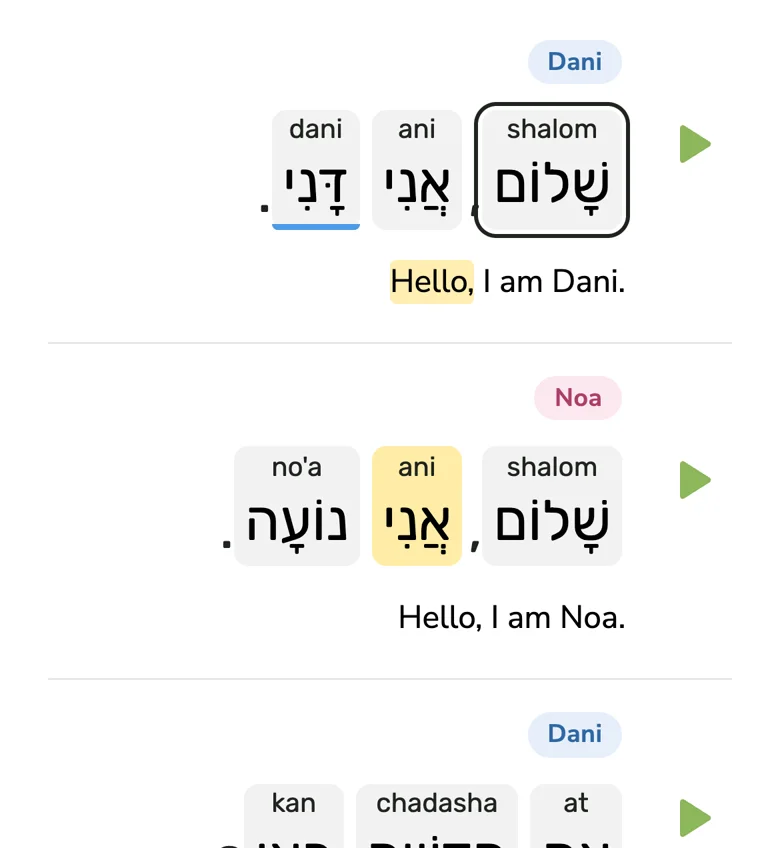
Every story has native audio
Every StoryOlive story comes with high-quality native audio, recorded for that story. You can play the whole story, one sentence, or a single word.
On HelloTalk, you hear real people in voice messages, calls and Voicerooms. They speak at everyday speed, which is hard to follow when you're starting.
1
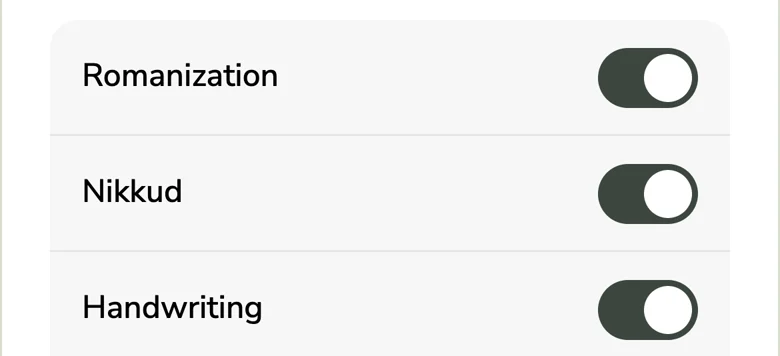
Advanced support for the Hebrew script
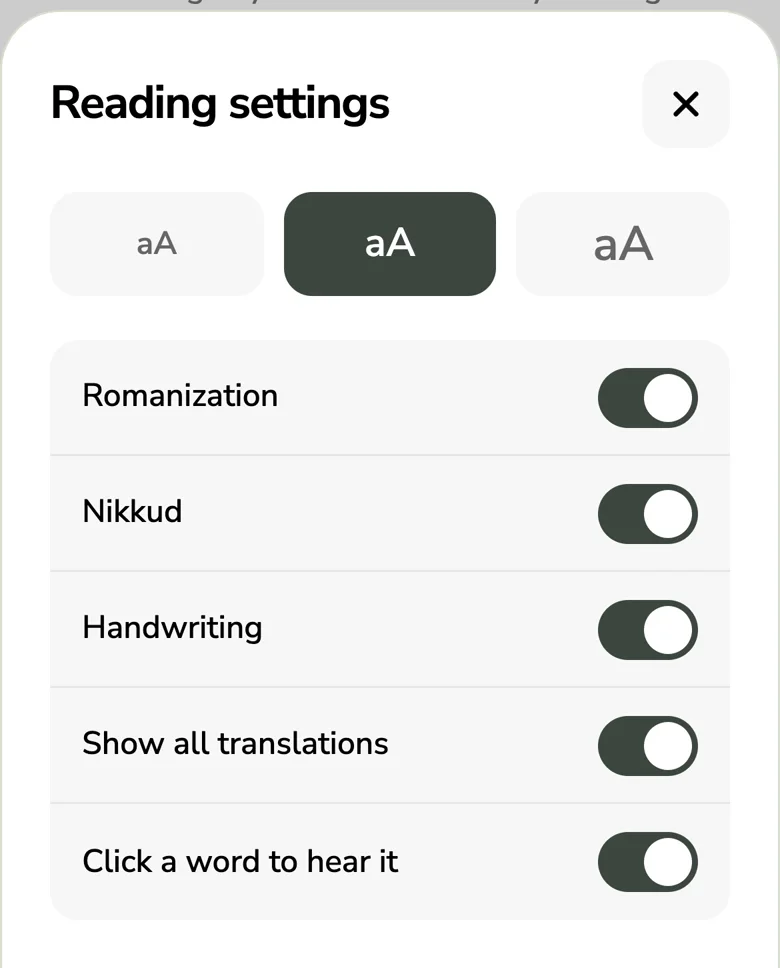
Keep the vowel marks (nikud) on while you learn, and switch them off when you're ready. You can also switch to handwriting, or show the romanization above every word.
On HelloTalk, Israelis type the everyday way, usually without vowel marks. So as a beginner, you often have to guess how a word sounds.
1
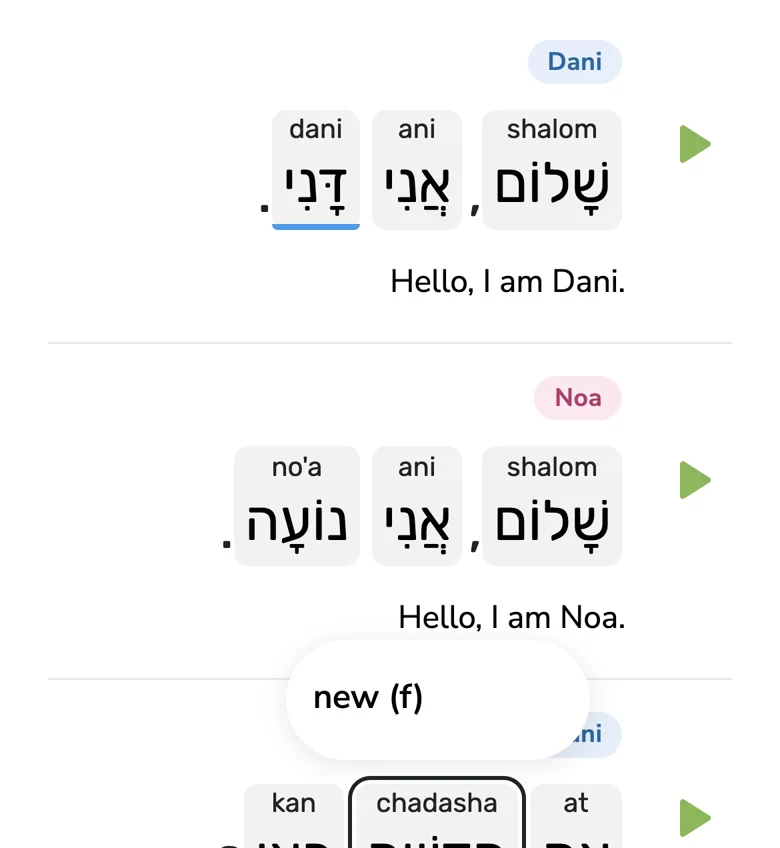
Tap a word to see what it means in that sentence
StoryOlive reads the whole sentence, not just the letters, so it shows you the right meaning. Without vowels, and are spelled the same, and you still get the right one.
HelloTalk translates a whole message at a time. On the free plan, you can only translate a limited number of messages each day.
2
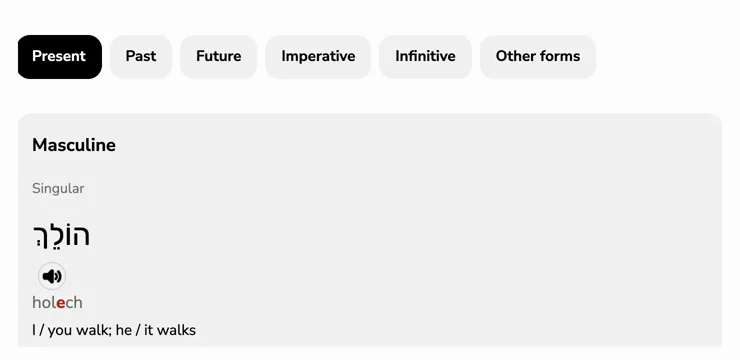
Every word has its own dictionary entry
Tap any word to open a full dictionary entry made for Hebrew. You see its root and its meanings, and for a verb, every form with vowel marks and audio.
HelloTalk doesn't teach grammar in order, as its own review says. Instead, partners and the AI correct the messages you write.
3
Stories at six levels, from beginner to fluent
StoryOlive has 1,278 stories at six levels, from beginner to fluent, and they're ready whenever you open the app. At the start, you can keep romanization and nikud on, and switch them off later.
HelloTalk has no levels. What you practise depends on who's online and what they want to talk about.
3
When HelloTalk makes more sense
If you can already write simple Hebrew sentences, HelloTalk lets you chat with Israelis and get your messages corrected, and most of its core app is free.
Hearing and reading lots of Hebrew you understand is one of the best ways to learn to speak it. When you've heard and read a sentence many times, you can say it yourself without stopping to think. StoryOlive gives you 1,200+ stories with native audio, so you have the Hebrew to say when you start chatting. 3
How much does each one cost?
StoryOlive
- Monthly
- $24
- Yearly
- $144 ($12 a month)
- Free
- Your first stories
HelloTalk
- Free
- With ads and a daily translation limit
- VIP, monthly
- $12.99
- VIP, yearly
- $79.99
US App Store prices.
 Checked in November 2026
4
Pros and cons
StoryOlive
- +1,200+ stories at six levels, from beginner to fluent.
- +High-quality native audio for every story.
- +Switches for vowel marks, handwriting and romanization.
- +Word meanings read from the whole sentence.
- +A full dictionary entry for every word, with every verb form.
- +Your stories are ready whenever you open the app.
- −There's no live conversation or writing practice with a person.
- −It costs more than HelloTalk VIP.
HelloTalk
- +You can chat with native speakers by text, voice or video.
- +Native speakers can correct what you write.
- +Most of the core app is free.
- −There's no course or set of levels to follow.
- −Chats are hard to follow before you know some Hebrew.
- −Messages usually come without vowel marks.
- −On the free plan, you can translate only a few messages a day.
How I wrote this comparison
I'm Robert, and I make StoryOlive. At the end of 2025 I was looking for an app to learn Hebrew by reading stories, and the ones I tried were clearly made for Spanish and French, with Hebrew added later. So I built one for Hebrew. I've tried to be fair here, and I've linked my sources below. If something is wrong or out of date, email me and I'll fix it.