
StoryOlive vs Pimsleur for Hebrew
If you want to read Hebrew, StoryOlive gives you 1,200+ stories at your level, with native audio. If you mostly want to practise speaking out loud, hands-free, choose Pimsleur.
Read a free story By Robert MacAlpine, founder of StoryOlive · Updated
| Feature |  StoryOlive |  Pimsleur |
|---|---|---|
| Stories written for learners | 1,278 stories at six levels, from beginner to fluent | No stories, 90 audio lessons |
| How far it goes | From beginner to fluent | 3 levels of 30 lessons, then it ends |
| Reading | Every story, with native audio | Reading lessons for letters and short words |
| Script switches | Nikud, handwriting and romanization, each on or off | None |
| Word meanings | Tap any word, picked from the whole sentence | Taught by sound in each lesson |
| Dictionary | 21,500+ entries, each with its root | None |
| Grammar | Root and every verb form on tap | Not explained, you learn by repeating |
| Verb forms | 120,000+ forms across 4,400+ verbs | No tables of forms |
| Speaking practice | By hearing and reading native audio | Answer out loud every lesson, with AI pronunciation feedback |
| Hands-free | No | Yes, with CarPlay and Android Auto |
| Price | $24 a month, or $12 a month yearly | $19.95 a month, or $149.95 a year |
| Read a free story |
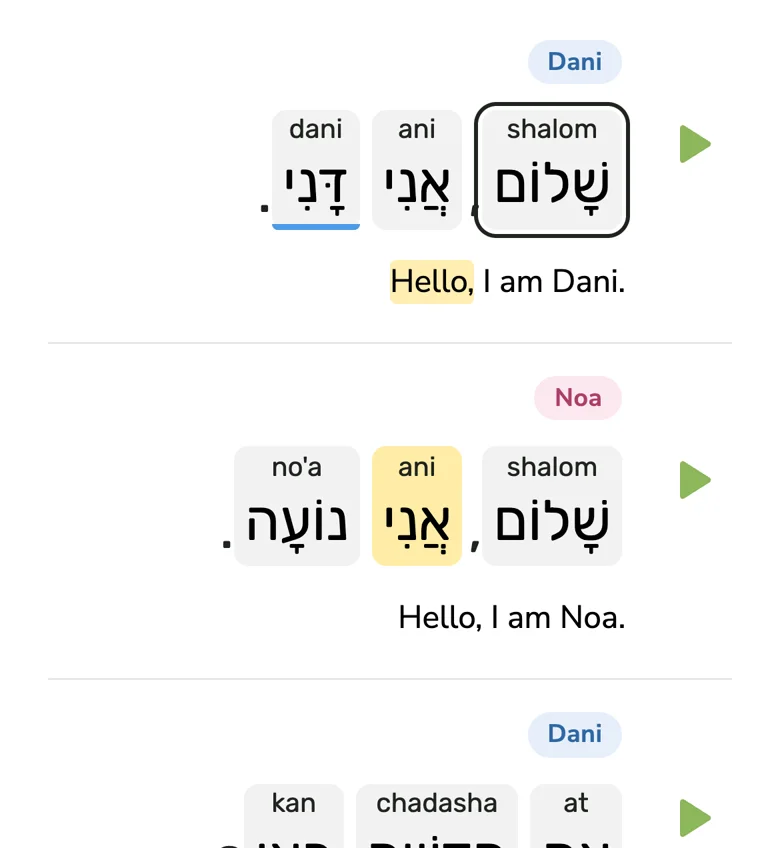
Read along with native audio
Every StoryOlive story comes with high-quality native audio, and you see the Hebrew text while you listen. You can play the whole story, one sentence, or a single word.
Pimsleur teaches mostly through audio. Its reading lessons practise sounding out letters and short words, not whole stories.
1
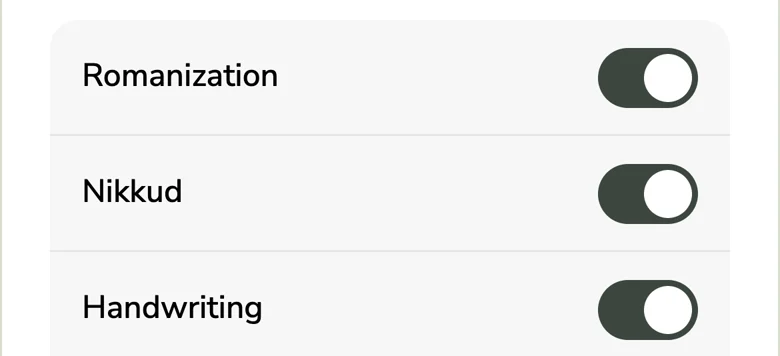
Advanced support for the Hebrew script
Keep the vowel marks (nikud) on while you learn, and switch them off when you're ready. You can also switch to handwriting, or show the romanization above every word.
Pimsleur has none of these switches, because most of the course is audio.
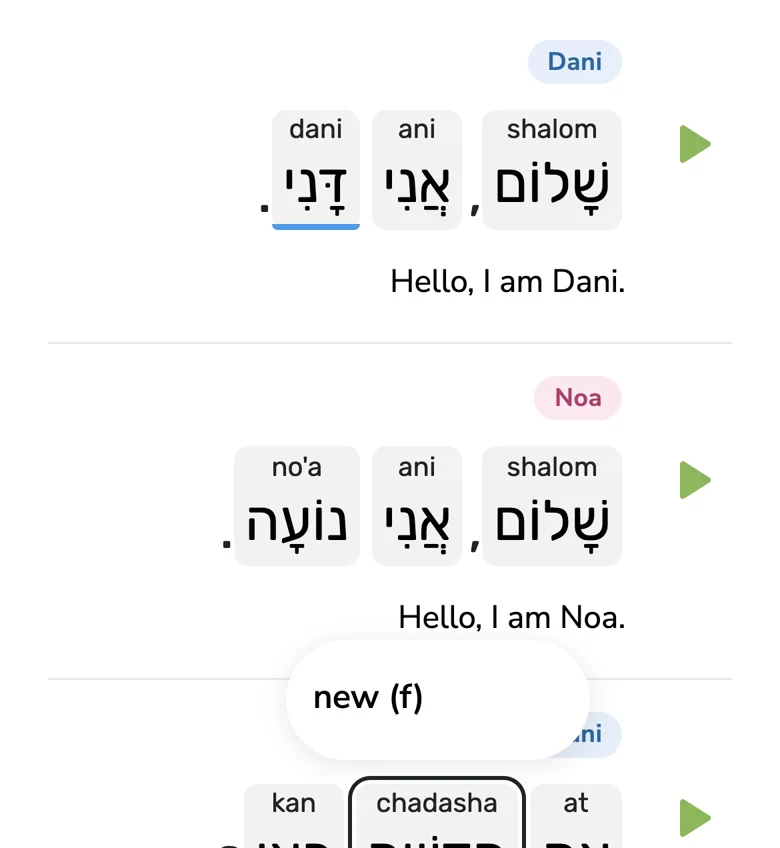
Tap a word to see what it means in that sentence
StoryOlive reads the whole sentence, not just the letters, so it shows you the right meaning. Without vowels, and are spelled the same, and you still get the right one.
Pimsleur teaches new words by sound, inside spoken conversations. It has no stories you can read and tap.
1
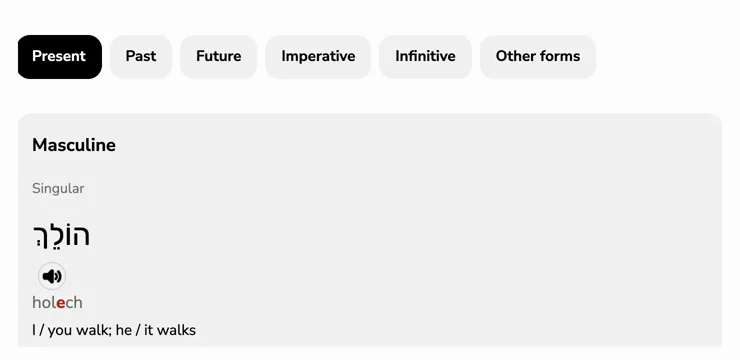
Every word has its own dictionary entry
Tap any word to open a full dictionary entry made for Hebrew. You see its root and its meanings, and for a verb, every form with vowel marks and audio.
Pimsleur doesn't explain grammar. You learn verb forms by hearing them and saying them back.
1
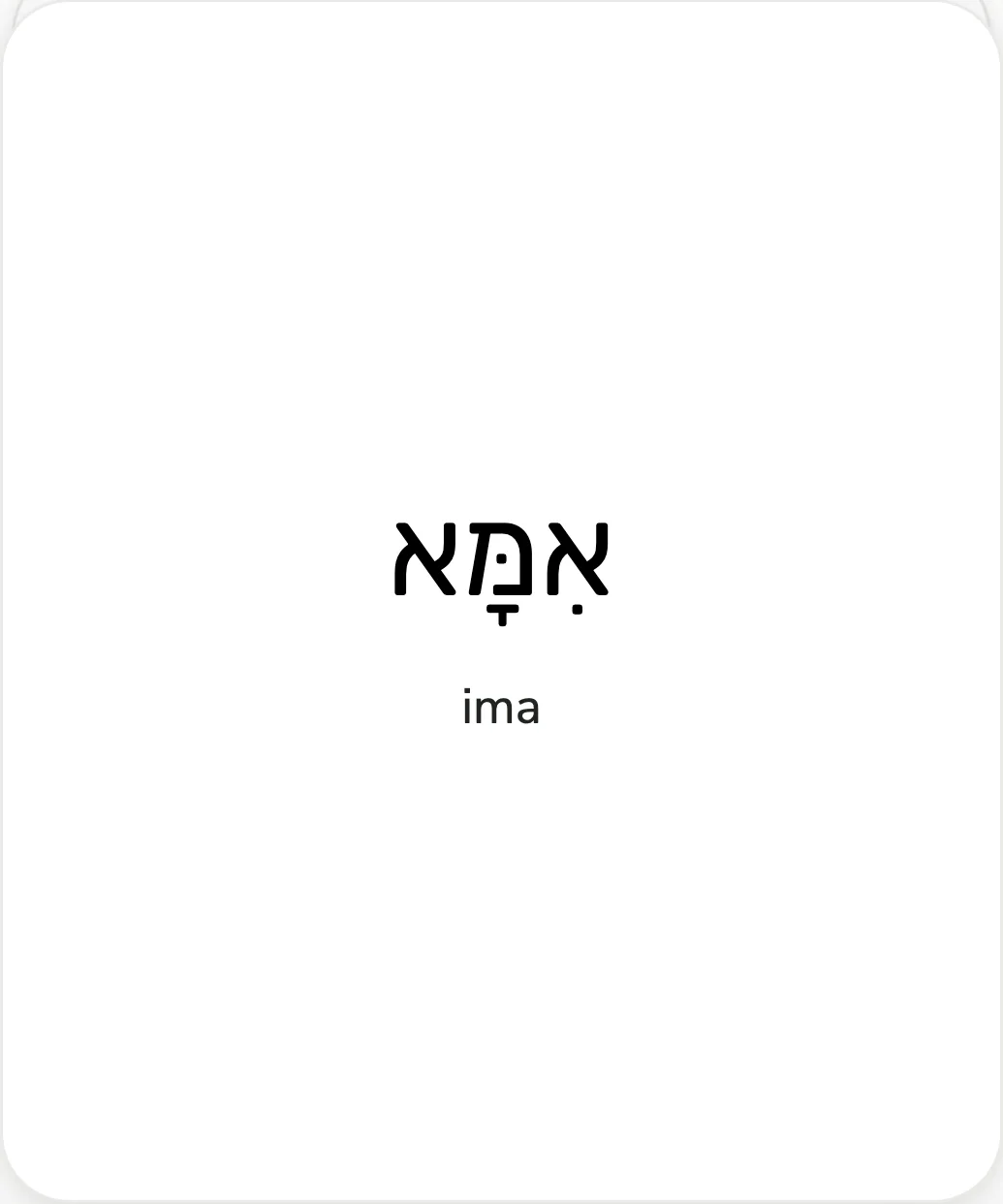
One flashcard for every form of a word
StoryOlive saves , and as one word, so you get one flashcard.
Pimsleur Premium has flashcards too, for the words in each lesson.
1
When Pimsleur makes more sense
If you want to speak out loud from the first lesson, Pimsleur makes more sense. You answer spoken prompts for 30 minutes a day, and you can do it hands-free in the car.
Hearing and reading lots of Hebrew you understand is one of the best ways to learn to speak it. When you've heard and read a sentence many times, you can say it yourself without stopping to think. Every StoryOlive story has native audio, so across 1,200+ stories you hear how Israelis really say each sentence, and you'll have far more to say. 1
How much does each one cost?
StoryOlive
- Monthly
- $24
- Yearly
- $144 ($12 a month)
- Free
- Your first stories
Pimsleur
- Premium, monthly
- $19.95
- Premium, yearly
- $149.95
- Audio only
- $14.95 a month
After a 7-day free trial.
 Checked in November 2026
2
Pros and cons
StoryOlive
- +1,200+ stories at six levels, from beginner to fluent.
- +High-quality native audio for every story.
- +Switches for vowel marks, handwriting and romanization.
- +Word meanings read from the whole sentence.
- +A full dictionary entry for every word, with every verb form.
- +Made for Hebrew only.
- −There's no live conversation with a person.
- −You need to look at the screen, so it isn't hands-free.
Pimsleur
- +You speak out loud in every lesson.
- +You can learn hands-free, for example in the car.
- −The Hebrew course ends after three levels.
- −Its reading lessons only practise letters and short words.
- −It doesn't explain grammar.
- −It has no switches for vowel marks, handwriting or romanization.
How I wrote this comparison
I'm Robert, and I make StoryOlive. At the end of 2025 I was looking for an app to learn Hebrew by reading stories, and the ones I tried were clearly made for Spanish and French, with Hebrew added later. So I built one for Hebrew. I've tried to be fair here, and I've linked my sources below. If something is wrong or out of date, email me and I'll fix it.