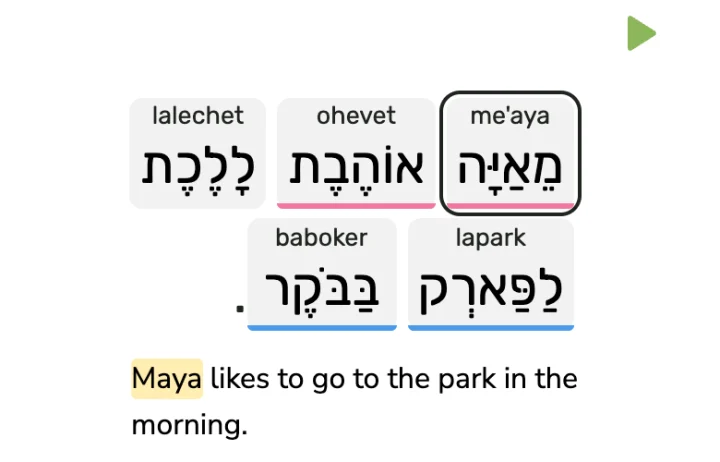
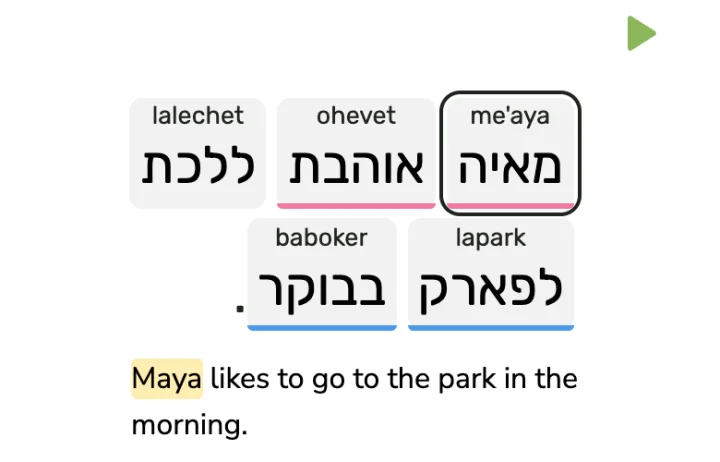
Hebrew vowels: the nikud marks and how to say them
Hebrew vowels are small dots and lines, called nikud. There are only five vowel sounds: a, e, i, o and u.
ba
Tap a letter, then tap a vowel mark. You'll see and hear the sound they make.

Hebrew has only five vowel sounds
-
aas in "father"
אָKamatz אַPatach אֲHataf patach -
eas in "bed"
אֶSegol אֵTzere אֱHataf segol -
ias in "ski"
אִHiriq -
oas in "more"
אֹHolam וֹHolam with vav אֳHataf kamatz -
uas in "flute"
וּShuruk אֻKubutz
Three of these marks have two extra dots beside them. Each one sounds the same as the mark without the dots.
Two more marks that you'll see
- אְ
Shva tells you there is no vowel after the letter. In some words, you say a very short "e" instead.
- בּ
Dagesh is a dot inside a letter, and it isn't a vowel. It changes v to b, kh to k and f to p.
Every Hebrew vowel mark, with its name and its sound
| Mark | Name | Sound | What it looks like |
|---|---|---|---|
| אָ | Kamatz | a, as in "father" | A small T under the letter |
| אַ | Patach | a, as in "father" | A short line under the letter |
| אֲ | Hataf patach | a, as in "father" | A short line with two dots beside it |
| אֶ | Segol | e, as in "bed" | Three dots in a triangle under the letter |
| אֵ | Tzere | e, as in "bed" | Two dots side by side under the letter |
| אֱ | Hataf segol | e, as in "bed" | Three dots in a triangle with two dots beside them |
| אִ | Hiriq | i, as in "ski" | One dot under the letter |
| אֹ | Holam | o, as in "more" | One dot above the letter |
| וֹ | Holam with vav | o, as in "more" | The letter vav with a dot above it |
| אֳ | Hataf kamatz | o, as in "more" | A small T with two dots beside it |
| וּ | Shuruk | u, as in "flute" | The letter vav with a dot in its middle |
| אֻ | Kubutz | u, as in "flute" | Three dots in a slanted line under the letter |
| אְ | Shva | no vowel | Two dots, one above the other, under the letter |
| בּ | Dagesh | b, k, p | A dot inside the letter |
Eight everyday words with their vowel marks
| שָׁלוֹם | shalom | hello |
|---|---|---|
| תּוֹדָה | toda | thank you |
| אִמָּא | ima | mom |
| אַבָּא | aba | dad |
| סֵפֶר | sefer | book |
| מַיִם | mayim | water |
| חָתוּל | chatul | cat |
| זְמַן | zman | time |
The Hebrew vowel marks and their sounds
You can tap each example word to see how to say it and what it means.
Patach is a short line under the letter, and it sounds like the "a" in "father".
Kamatz is a small T under the letter, and it also sounds like the "a" in "father".
Segol is three dots in a triangle under the letter, and it sounds like the "e" in "bed".
Tzere is two dots side by side under the letter, and it also sounds like the "e" in "bed".
Hiriq is one dot under the letter, and it sounds like the "i" in "ski". It's often followed by the letter yod.
Holam is a dot above the letter, and it sounds like the "o" in "more". In most words, the dot sits on top of the letter vav.
Kubutz is three dots in a slanted line under the letter, and it sounds like the "u" in "flute".
Shuruk is the letter vav with a dot in its middle, and it also sounds like the "u" in "flute".
Shva is two dots, one above the other, under the letter. Sometimes you don't say it at all, and sometimes it's a very short "e".
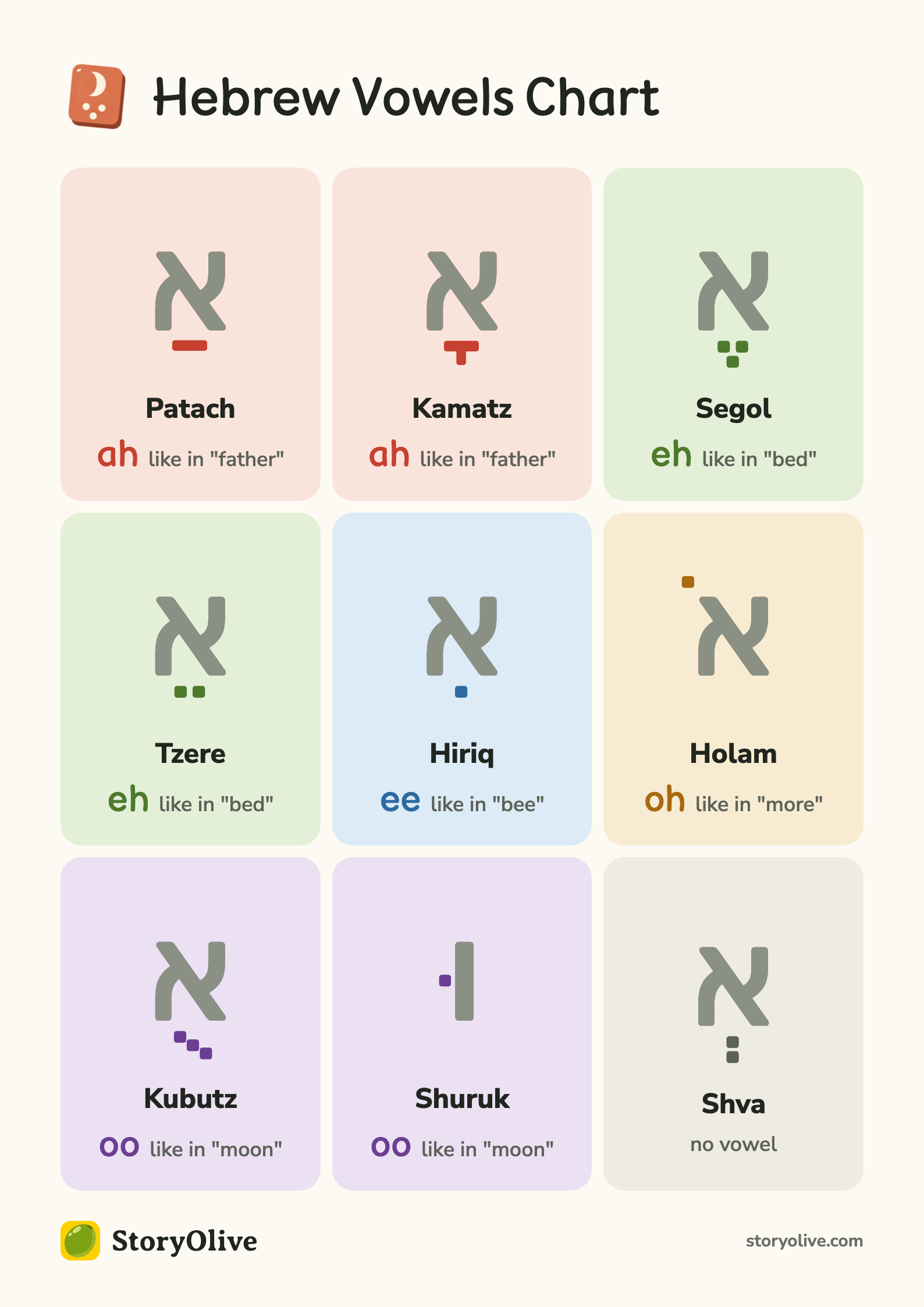
Printable Hebrew vowels chart
Why do two marks make the same sound?
Don't get confused! Some marks look different, but in Modern Hebrew they sound the same.
Patach and kamatz both sound like the "a" in "father".
Segol and tzere both sound like the "e" in "bed".
Kubutz and shuruk both sound like the "u" in "flute".
Why most Hebrew has no vowel marks
Fluent readers know the words, so newspapers and signs in Israel leave the marks out. Then one spelling can stand for several words.
How to read without vowel marks
 In StoryOlive, you can turn the vowel marks on and off in every story. When a story feels easy, read it again with the marks off.